INFORMATICA · ENTERPRISE DATA · PRODUCT DESIGN
Making complex data lineage understandable
Data teams could see source records, but understanding how a master record was created required reconstructing relationships across dense tables and fragmented views. I redesigned the experience to make lineage, contribution and conflicting values easier to investigate.
Hours → minutes
Lineage investigation time
78% fewer
Lineage-related support tickets
85% adoption
Within the first 3 months
01 · THE CHALLENGE
The product displayed the data, but users still had to reconstruct the story themselves.
The existing Source Records experience placed record values side by side in a dense table. It exposed information, but gave users little help understanding which source contributed a value, how records related to one another, or why the master record looked the way it did.
Relationships were implicit
Users had to infer how source records connected to the resulting master record.
Important signals competed with detail
Large volumes of attribute-level data made it difficult to know where to start.
Investigation required mental stitching
Users had to compare values and preserve context while navigating dense information.
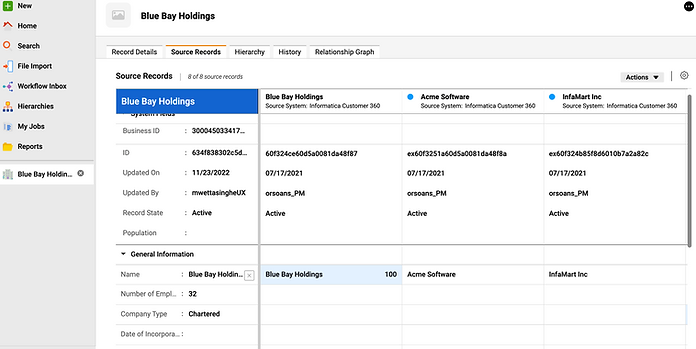
Before · A dense comparison table exposed source data but not a clear explanation of lineage.
02 · WHAT RESEARCH CHANGED
Different users needed different depths of understanding, not different products.
Interviews and support-ticket analysis showed that the design needed to communicate the high-level story first while preserving enough depth for detailed investigation.
INSIGHT 01
Users wanted the story, not another table
They needed to understand how a master record came together, not simply inspect more values.
→ Make lineage visible as a relationship
INSIGHT 02
Not everyone needed the same depth
Business-facing users needed a quick understanding of the record, while data stewards still needed access to detailed source-level information.
→ Reveal detail progressively
INSIGHT 03
Context was easy to lose
Investigation became harder when users had to move between disconnected views to understand competing values.
→ Keep exploration anchored in context
03 · DESIGN DECISION
01
Reveal the health of the record before exposing every detail.
I reorganized the experience so users could begin with source contribution and quality signals, then move deeper only when they needed to investigate a specific attribute or source.
OVERVIEW FIRST
Surface contribution, required attributes and key attributes before row-level detail.
VISIBLE PRIORITY
Use hierarchy and status signals to make anomalies easier to notice.
DETAIL ON DEMAND
Keep deep investigation available without making it the default state.
BEFORE · DETAIL-FIRST
Everything competes for attention
AFTER · LAYERED UNDERSTANDING
Start with what matters, then investigate


Contribution by source is visible immediately.
Quality and attribute signals establish where attention is needed.
Deeper comparison remains accessible without dominating the overview.
02
Turn lineage from something users infer into something they can follow.
The redesign made record ancestry visible as a navigable relationship. Instead of mentally reconstructing how records contributed over time, users could see the chain and use it as an entry point for investigation.
Show relationships explicitly
Represent record ancestry visually rather than leaving it buried in table structure.
Keep the current record anchored
Users can understand where they are while exploring contributing records.
Use the visualization as navigation
The lineage becomes an investigation tool rather than a static diagram.

Ancestry · The contributing record history is visible alongside the source record context.
THE DESIGN SHIFT
The old experience made users reconstruct lineage mentally. The new experience made the relationship itself part of the interface.
03
Let users investigate competing values without losing their place.
Deep investigation still required dense information. Rather than removing that complexity, I kept it contextual, allowing users to examine source contributions and compare values while remaining anchored in the same investigation.

Contextual exploration · Source contribution and competing values can be inspected while the ancestry remains visible.

Comparison · Users can compare the master record against contributing sources side by side.
PRESERVE CONTEXT
Keep the investigation anchored instead of sending users through disconnected screens.
COMPARE DIRECTLY
Place competing values side by side so users do not have to remember information across views.
KEEP EXPERT DEPTH
Detailed source-level data remains available when the investigation requires it.
04 · BRINGING THE EXPERIENCE TOGETHER
A layered investigation flow: from signal, to relationship, to evidence.
01 · Orient
Start with contribution and quality signals to understand where attention is needed.

02 · Trace
Follow the contributing record relationships.
03 · Compare
How to show


THE EXPERIENCE MODEL
Overview → relationship → evidence
Users can increase the depth of information as the investigation demands it instead of confronting the full complexity upfront.
05 · OUTCOME
From a dense record table to an investigation experience users could reason with.
Hours → minutes
Lineage investigation time
78% fewer
Lineage-related support tickets
85% adoption
Within the first 3 months
CONCLUSION
The redesign did not simplify data lineage by hiding technical information. It simplified how users built understanding, starting with the big picture and revealing deeper evidence as the investigation required it.